

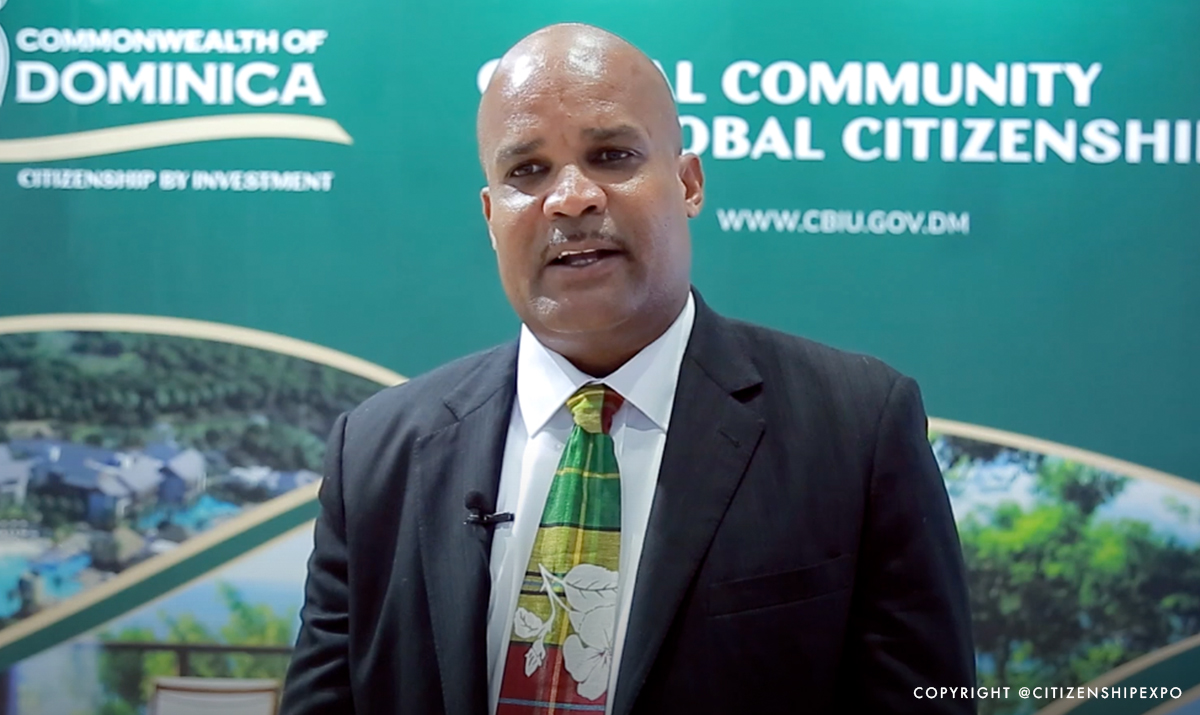
09 Jul Interview with His Excellency Ambassador Emmanuel Nanthan, Head of Citizenship by Investment Unit, Dominica
Dominica’s Citizenship by Investment (CBI) program has garnered global recognition. What key factors have contributed to the sustained success of the program and how has it evolved since 1993?
Over the years the program continued to maintain a steady ranking because of the trust in it. A lot of people know about it in Dominica – they have friends, relatives or family who became citizens and have been citizens. We have developed a lot of trust and credibility among investors and potential investors.
The program is very well recognized because of its durability and accountability. In Dominica, people can see what’s happening with it. When you talk about Citizenship by Investment and you talk about hotels, houses, marinas, national improvement programs — there are many initiatives that people can see and they can account for the investments done in Dominica coming from the program as such. The program has been very impactful in Dominica. Every area of life has been affected by it through the creation of jobs. On the economic impact, we have done work in hotels; we are building about eight 5-star hotels, we have infrastructure projects after we were affected by hurricanes. We had to rebuild our roads and bridges and a lot of funds from that came from the program. We have done infrastructural development in terms of schools. We have built several schools with funds from the program and those also create jobs. We have built hospitals and 17 health centers in the north, south, east and west of Dominica. In addition, after Hurricane Maria 2017, we needed to build a strong new Dominica for housing and resilient houses. We have built over 2,000 homes and given them free of charge to families. The jobs created in the construction of the homes too have been very important.
Outside of that, we have a national employment program where young people are given jobs where they gain experience and be paid for by the government using funds from the program. We also target elderly people who were left at home by children who went to see green pastures elsewhere. We did a program called the “Yes, We Care” program where we pay people to go to the homes of the elderly to take care of them daily. The impact has been tremendous all around Dominica.
Could you elaborate on the benefits and differences between investing in the Economic Diversification Fund and in real estate as means for investing in the program?
We have two distinct routes to citizenship in Dominica. One could be investing directly with the government and that is via the Economic Development Fund. A lot of the programs in infrastructure were done under that program. For instance, the funds we use for our infrastructure development could be roads, bridges, schools, hospitals, the national employment program, or the Yes, We Care program. All those are funds that the government uses directly and people can see where those funds are going.
We also offer the other route, which is real estate, where the government has identified several areas where it would be beneficial to the country to have those programs going. For instance, tourism is a major economic impact program in the Caribbean. Several people have come to the government and said they would like to build a hotel in Dominica. At present, we’ll be doing around eight of them and they’re all 5-star hotels. We have global chains coming in and being built — we have an Intercontinental now opened at Portsmouth; we have Tranquility Beach, a Hilton hotel, being done on the West Coast; we have a Marriott Autograph Collection hotel being done. Then there are several other smaller hotels.
Largely, the real estate has been involved in hotel development but the international airport is also ongoing and one supports the other. It will bring in tourists who will stay at the hotels, which are the real estate project. It is a well-thought-of, well-planned strategy where one complements the other. The idea and hope are that it will help elevate and sustain good economic development for Dominica going forward. The idea is to have sustainable job creation and sustainable development for future generations. We just broke ground on a marina project that will be done under the EDF program. That, too, will bring in more tourists for yachting and that will help development as well. We’re also doing the world’s longest aerial tram to the second largest boiling lake and all that’s been done under the EDF and the real estate again, trying to sustain tourism development for the country.
The minimum investment under the EDF is $200,000 plus the necessary fees such as due diligence fees, etc. For real estate, it is a minimum of $200,000 as well. It has to be done through an agent who would then be in contact with the government. We don’t accept the application directly. All the agents are available online on the government website cbiu.gov.dm
Can you describe how the due diligence process keeps the CBI program safe and credible?
In Dominica, allowing people to come into your country and granting them the rights of citizens is a process that we take very seriously. As a result, we ensure that we do a thorough due diligence. Our due diligence process is four-pronged.
First your agent, in submitting your application, must submit a copy of the world check that they have done on you. They should have used one of the world travel agencies to do a check which is paid for and supplied to us. When we get the application, we go through intelligence where we send the information to an intelligence network called GRCC or Impact. That is a network that serves all of the Caribbean community and works with the partners, the US, the UK, Europe, Canada and runs the names against all checks that are there. The names are vetted by that regional agency to ensure that the people who are applying are not flagged for any terrorism or financial crime, any security threats and they are not being monitored and that they have not had visa rejections in any of our partners where we have visa-free access. With several international agencies that work for the largest financial institutions in the world, agencies mainly in the US and the UK, they enhance virtual and on-the-ground due diligence on each applicant and their family on our behalf. They send that to us and our trained staff would go through the reports to look at the problems and concerns and say whether or not we will accept or not accept these people. In recent times, we have also added our financial intelligence unit as part of our process and this will go through the files to ensure that the legal matters and the financial aspect of the applicants are well in order before they are accepted as citizens of Dominica.
The reports will give us information about the schools where they went to (primary, secondary and university), they will give us the industry where they work, there will be interviews with people they worked with within the jurisdiction where they operate, they will check in every place where they lived for more than six months over the last 20 years. They will give us pictures of the homes and the offices. All of those things would be provided to us for our assessment and review. And they can be joined by their families then in Dominica.
Dominica offers a unique eco-tourism experience. How does the CBI program support and enhance Dominica’s eco-tourism initiatives?
Dominica has been known as the Nature Island of the Caribbean, if not the world. Dominicans, by and large in general, are nature lovers. To try to enhance the natural beauty and the natural attributes we have, our program has the NEP, the National Employment Program, where we have a large beautification group active in every community and goes about planting flowers and maintaining the landscape. That’s done in every community in Dominica as part of the funds coming from the Citizenship by Investment program. We try to enhance the natural beauty of the country by keeping it clean, using funds from the program.
We are now building the world’s longest aerial tram that will take you to the world’s second-largest boiling lake. We are enhancing, exposing and giving the world access to the natural beauty of Dominica to be able to see our boiling lake. We use and make use of nature as well. Because of the natural attributes we have – including several hot springs and volcanoes — we have also invested heavily in a geothermal plant. We are looking to produce a large percentage of our energy cleanly, using our geothermal resource to provide energy for all citizens of Dominica and hopefully in the future to be able to sell clean energy to our neighboring islands as well.
How does Dominica collaborate with other countries and organizations to ensure the success and credibility of its CBI program?
We have started and had very good talks with the US Treasury Department. They work with us, with the European Union and with Britain. We have signed with the rest of the Caribbean countries that have a program for six principal projects with the US Treasury, where we are doing things to improve and enhance our program. We continue to engage our partners, be it the EU, the US, the UK and others, to ensure that the people who are coming in are properly vetted and for them to give us guidance and advice on what we should or should not do in terms of the industry and accepting people and to make our program stronger, better programmed, to make it more robust, to protect the rule of law and to protect the national security of our country and the partners that allow us to have visa-free access to their countries.
Over the last five years, we have seen a significant increase in the number of US citizens who are becoming investors in Dominica and we’re very pleased about that. Hopefully, over the years, they will continue to expand and we look forward to having more and more. Quite a few investors are investing from the US and Canada. During the cold winter seasons in the Northern Hemisphere, they could fly three, four or five hours and they could be here in Dominica enjoying our sunshine and our hot springs and whale watching. We have created the world’s first reserve for sperm whales in Dominica. There are just so many beautiful things to enjoy: the waterfalls, the rivers, the forest and of course, the bubbling Champagne Beach as well. We look forward to having new investors invest and, importantly, visit Dominica and enjoy the beauty of the Nature Island of the world.
Sorry, the comment form is closed at this time.