

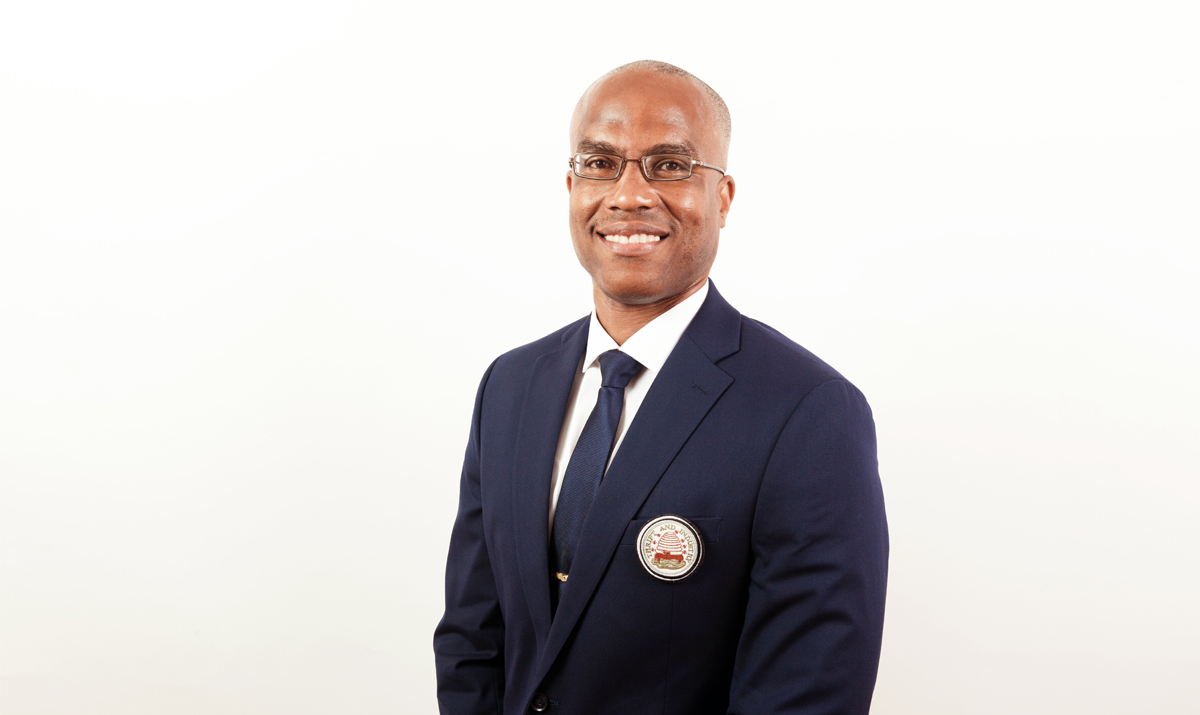
10 Jul Interview with Larry Lawrence, Managing Director, Grenada Co-operative Bank Limited
Grenada’s banking sector is known for its well-regulated framework with the market offering stability. How does your vision for your bank align with the wider economic realities to best serve your clients?
The vision of the bank as articulated by the Board of Directors and management is in our mission statement: that we provide high-quality financial services and contribute to the well-being of the citizens where we operate. Part of the ethos of the bank and what motivated the formation of the bank, is the lack of access to financial services, or banking services at the time, by a certain class of people. Its mission, firstly and very simply, to ensure that everyone has access to banking services. Naturally, if there are positive economic realities, if you have access to banking services and if you consider what an economy is – an economy essentially is the sum total of all the transactions in that economy – if you seriously break it down as a buyer and a seller, what the buyer has is money or credit and the seller has goods and services or a financial asset. A sum total of all the transactions in an economy is by having banking services available to all. Then you will facilitate the economic realities and every person who is trying to improve their life has access to financial services, to credit, to a credit card or debit card, to facilitate transactions. All the transactions invariably lead up to the economy because of the total spending in an economy.
Simply put, this is what Grenada Cooperative Bank facilitates. We will hold to our ethos of ensuring everyone has access to banking services and by extension you have a thriving economy, then you facilitate transactions. As a direct result, everyone can improve their lot in life, everyone can work and spend and facilitate the improvement and attraction of wealth to their respective families and communities.
The Eastern Caribbean Dollar, pegged to the United States Dollar, enhances the efficiency of international transactions. How does this impact your bank’s operations, especially in terms of attracting American investors and partnering with the US in businesses?
Any country would want to facilitate foreign direct investment, which means you have to attract investors. If there is stability in foreign exchange dealings, that influences the confidence of investors to participate in foreign direct investments into Grenada. But importantly, also, the supply of foreign currency itself is quite stable. Just as the investors send monies in the act of investing, the investors also show in terms of stability of the exchange rate. When value is conferred, it’s conferred at a rate that is predictable and known. When the investors remit earnings, profits and dividends back to their home country, that’s also possible. But it’s also known what the exchange rate is. That does indeed promote that sort of stability and confidence that an investor can participate in any investment initiative. That means that they have to acquire currency, Eastern Caribbean dollars, to facilitate the investment, but in the same vein they can exchange the Eastern Caribbean dollars upon having performed the investment so that they can remit profits and dividends back to their home country.
According to the IMF, Grenada’s economy is expected to grow at an average rate of around 4.3% percent during 2024-25. What would you say are the main factors impacting this positive momentum and how does Grenada Co-Operative Bank plan to leverage this growth trajectory?
Economic growth and being able to sustain economic growth year after year, in part has to do with proper governance at the government level. Our Fiscal Resilience Act enshrines in law a particular disciplined approach that the government has to facilitate a particular behavior that it prescribes, so that there is confidence by the public, by the business community, in the actions and fiscal initiatives of the government, so that there is, the ability to meet your obligations. That will be typically communicated in the form of a national budget.
What does the bank do? Of course, we would follow the national budget. We will spot opportunities based on planned expenditure. The government will have a capital expenditure program, a recurrent expenditure program. Areas of focus will see our attention being diverted and being prepared to have policy changes within the bank products itself, that will satisfy the thrust of the government and what they hope to promote, for that year in particular.
Having regard to proper fiscal spending and following the national budget – because that all will be articulated – we certainly will have the opportunity to participate fully and contribute to the well-being of the citizens where we operate.
You have a booming tourism sector, together with an expansion in agriculture initiatives and advancements in crucial infrastructure projects. What partnership opportunities do you see in these thriving sectors?
Given that tourism is the most thriving productive sector and we have seen it rebound in a phenomenal way since the covid pandemic, there are spillover effects from tourism into areas such as agriculture because there is an initiative to want to supply the hotels. There is also other critical infrastructure, such as roads, to facilitate farmers being able to easily transport their produce to market. In terms of other initiatives: ensuring that farmers have access to water from the river, pumps and the infrastructure to facilitate agricultural initiatives. We have seen improvements in agro-processing allowing fruits for example, that are in abundance at a particular time to be stored and packaged and processed later. Any other infrastructure that is consistent with a growing economy, like a simple matter of having improved police stations, or ensuring that the bridges are upgraded to facilitate increased traffic.
The bank will partner with the government ensuring that foundation building, that we do our part in participating. We are very much open to infrastructure loans because they are for the public good, be it to upgrade the airport, deal with any of the state-owned enterprises, helping with low-income housing for example, that the government may want to promote. We will be on board with ensuring that we facilitate these initiatives by the government.
How does your bank benefit from Grenada’s citizenship program and why should international people choosing this path choose your bank as their local partner?
This is an area that the bank is most proud of. The CBI program has recently been rebranded to the IMA, the Investment Migration Agency. It was an initiative by the government that had national implications. The bank being an indigenous bank for the people decided to participate and assist the government in this initiative. But it did so carefully because investment migration is deemed high-risk and we have followed a program that was compliance-centric and worked closely with the Committee, at the time CBI, to ensure that the investor inflow met the highest standards possible.
We have the highest standards for investors and there is a lot of due diligence on the nature and type of investors that are able to participate in the program that served us well and continues to do so. The bank is happy to facilitate these transactions because that’s what we do: ensure that the transaction is facilitated. But the country is who benefits. We are happy to have supported a major national initiative by the government, which is to the benefit of the country. We have been able to keep it clean. We have not had any embarrassment following through on what we deem to be robust due diligence, which has led to efficiencies in the program, which has satisfied all of the stakeholders. We have nearly been, I think, the sole bank that has been facilitating the investment migration in the country.
As one of the most recognized institutional brands in the country, what would you say are the main attractions to American investors today about choosing Grenada?
Safety, the culture and the friendliness of the people. I say that without hesitation because it is true. If you go to the urban areas of the country or you go to the rural areas, the people are genuinely friendly, they’re genuinely curious, not in an invasive way, but you open yourself to the people, you go sit in any of the restaurants in the rural areas to have a meal, you feel safe. Safety, in and of itself, is certainly one of the avenues by which anyone, investor or tourist, comes to the island. That genuine friendliness of the people that you don’t feel harassed. It’s just part of our culture, our DNA. That, for sure, I do believe will be our principal selling brands for persons coming into Grenada.
In terms of the bank, it would be that we facilitate people being able to bank easily once they come to the island and we have a network of branches throughout the length and breadth of Grenada. We have branches in rural areas. We have a branch in Carriacou which serves Carriacou and Petite Martinique. We have several offices in the capital areas of the island. Having that comprehensive branch network, comprehensive services and electronic banking services, we still are able to not only attract through friendliness and safety but also to ensure that when persons come here, transactions themselves are possible.
How do you attract the diaspora to use your services?
We have a program of traveling to the diaspora at least once a year and persons who also come back to Grenada for the independence celebrations as we recently celebrated 50 years. There is a thriving diaspora relationship with the island and by extension with the bank because persons at some point have migrated, but they remain plugged in and connected to the island and often it is through the bank to be able to facilitate their transactions. Maybe in September, the team will travel into the thriving areas for the diaspora, to the US for sure, to meet and to enquire about the needs of the members of the diaspora.
What would be your final message to the readers of USA Today regarding Granada and doing business in Grenada?
We want to encourage foreign direct investment into Grenada. The bank is here to facilitate that. We want to encourage people to visit Grenada, spend a week and feel the hospitality of the people. The bank is here to facilitate those efforts and transactions. The hotels do a large share of banking with us. You can use our ATMs when you get here to facilitate access to cash and access to commerce. We want when they get here that they are prepared to spend lavishly. We want them to go and visit rural areas, not just stay in the hotels. The bank is here; we don’t intend to be going anywhere. In other words, we tend to stay in business perennially.
Sorry, the comment form is closed at this time.