

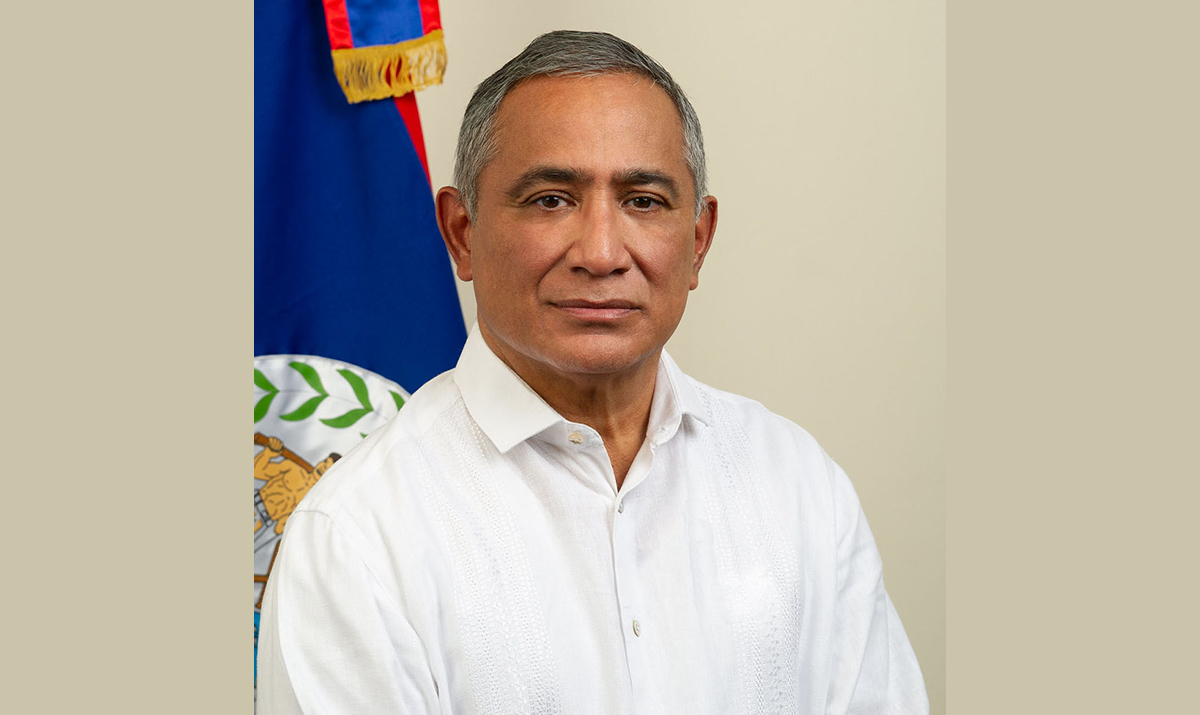
29 Feb Interview with John Antonio Briceño, Prime Minister of Belize
Could you tell us about the economic trajectory Belize has followed over the last few years, especially after the pandemic, and what are the key economic advantages the country can rely on for its development?
Belize is the size of the state of Massachusetts, but unlike Massachusetts which has a population in the millions, we only have 400,000 residents. We believe that for us to get the country moving, to create opportunities for people, to get them out of poverty, we must create the necessary environment for foreign direct investments (FDI).
We have a friendly investment climate, and because of our history with the British, the rule of law is strict. This means when investors come to Belize, they feel at home, believe that a contract is enforceable, and that the courts are available for them should they have any concerns.
It is important to note that we have a fixed exchange rate of two Belizean dollars to one US dollar, and that has been in place for several decades. I know, for instance, that the IMF would frown about fixed exchange rates, but now they have come to realize that a fixed exchange rate for a small economy like Belize is effective for us. They have also pretty much endorsed that fixed exchange rate.
We have a parliamentary system, or the British Westminster Parliamentary system, which ensures stability. Once we have an election, within a minute of the result being announced, we already know that that party is going to be the new government.
Another important point for your readers is that Belize is uniquely positioned. We are part of the Caribbean, but also part of Central America. We are positioned to access both the CARICOM markets and the Central American markets, while also enjoying access to Mexico and even the US, which is the largest market in the world.
Our financial system has been quite stable, even when we have had problems like, for instance, in 2008 and during COVID-19. We have ample foreign exchange and liquidity, a strong regulator, through the Central Bank, and they are independent. So, even through the recessions and the recent market turmoil, Belize has been stable. When you look at the recent FDI stories since we got into government, the IMF predicting our 2021 growth was going to be just over 3%. Well, we ended up with over 15% GDP growth.
Then last year they said we would have around 6% growth, but we ended up with over 11%. That is because we have an open market, are open for business, and encourage foreign investors to come to Belize. Indeed, last year we surpassed our FDI record from 2019.
In two short years our government has turned things around in Belize. We have managed to reduce the unemployment rate by more than half – to about 5% – and now have an annual FDI rate of 4-5% of GDP.
On infrastructure development and investments, it is very important to facilitate FDI. We are opening the Satine Road that is on the northern tip of the country, facing the Caribbean Sea. We are building a highway that could give access for tourism, agriculture, and investments in that area. More than $130 million of investment is also earmarked for upgrades to Philip S.W. Goldson International Airport in Belize City.
We are also working on developing our cruise ports. We have three companies that have expressed interest and are working with them to see which one would secure the necessary environmental approval. Once they do that, we can give them whatever support they need. We are doing everything possible to boost FDI into Belize.
Belize’s first national investment policy and strategy aimed at positioned the country as a competitive, robust, and viable investment hub in Central America and the Caribbean by 2030, was recently approved. What are the opportunities specifically for US investors that will be showcased at this August’s Investment Summit?
There are a lot of people that do not know enough about Belize. By having these investment summits, we put all the players of the government in one space, where potential investors can come and get all the information they need, and for us also to be able to listen to them, and hear what their intentions are, what is it that they want to do, what they believe that they may be facing, and for us to be able to hold their hands, and walk them through it.
By holding these investment summits, we invite different groups. We have different seminars where people can come and listen. We also invite successful investors to tell their story, and to point out what has worked well and what has not.
It is important for us to point out, especially to American investors and to American citizens, that Belize shares excellent relations with the US. We work with them on different topics, for instance, on FDI and immigration. The year after we were elected, the US government, through the Millenium Challenge Corporation (MCC) – a private firm financed by the US administration that seek out democratic countries open for business and working to reduce poverty – chose us as one of two nations for a Compact Development Funding Grant Agreement.
We decided to concentrate on the issues of education and clean energy, signed that agreement and now are working with them in how to restructure education, to see how we could make our education more relevant, and to be able to tie education with the economy because it is useless to be educating your people to be white-collar workers when you do not need white-collar workers. We need people to work in the fields, in tourism, we need entrepreneurs, electricians, plumbers; all these things for us to be a successful country and an economy that can grow.
We have exceptional connections in the US with daily flights from Houston, Dallas, Miami, and Atlanta. We have weekly flights from Newark, Chicago, Minneapolis, Charlotte, and as far as Seattle. We have reliable cargo in air and sea, to and from the US. We are positioned in the right place to be able to encourage FDI in Belize.
Last year I had a meeting in Washington D.C. with Secretary of State Blinken, where we spoke on many of these issues, and how we can collaborate even more closely. Although we are a small country, by working together there is so much that we can do, and where we can use our influence in CARICOM and in Central America through CICA.
The US is Belize’s main trading partner and leading source of investment funds, as well as home to an estimated 300,000 Belizeans. How important are trade relations with the US, and what projects are you working on to further tighten trade ties?
We import around 50% of our goods from the US and we have been working with them to open more markets for our products. For instance, we export a small amount of sugar to the US, and lately they have afforded us another 4,000 tons, so we have 14-15,000 tons that we can export to the US. We are looking at exporting other products, like cattle that we currently send to Mexico, as well at organic products and mahogany.
Each year, around 400,000 American tourists come to Belize. That also helps us with the trade balance. We want to make it easier for them to come and to feel safe and at home. Belize is a special place. We are warm, friendly, open, and that is what many Americans love when they come here.
With a recent increase to the minimum wage, your government has taken steps to reduce poverty rates. How has Belize addressed the challenge of keeping young, skilled workers?
That is certainly a challenge for Belize, but the only way we can reduce poverty is by having a robust and growing economy. We are creating opportunities for people and for micro, small- and medium-sized enterprises, which is probably about 85% of our businesses. We are creating opportunities for young people and for women through the MSME program that we are setting up. We provide training and, in some instances, small funds for them to start their businesses through the Development Finance Corporation (DFC), which is a development bank. We are also making funds available for them to invest.
We need to create an entrepreneurial culture here. People often just seek out work with a fixed salary, but while that may give you some kind of comfort, if you are your own boss, you can create more opportunities. This is one reason why you have many Americans coming to Belize because they see these opportunities and they are investing in our country.
We are telling the young people that there are opportunities, if you are prepared to put in the effort. On the government level, we are prepared to assist you, to hold your hand, to walk you through, to teach you a little bit about financial literacy, some things that many take for granted because they went to university and studied business.
Of course, they could go to the US, albeit the cost of living is way more. But if they stay home and have their own business, they could probably live better than if they went to the US, and I mean no disrespect to those living in the US. When I graduated from university, I had an aunt living in Jersey and she could not understand why I left the US for Belize, but it was the best decision I ever made. We have a responsibility to give back to our country. Our country has given so much to us and now we need to give back.
Talking about sustainability, Belize has signed an agreement with The Nature Conservancy (TNC) to protect 30% of its ocean space by 2026. Meanwhile, Hurricane Lisa showed that climate change can have a greater impact on countries exposed to the ocean. What climate change-related challenges does Belize face, and how is the five-year Marine Conservation and Climate Adaptation Project addressing those issues?
Whenever I touch upon this subject, I am frustrated because as I pointed out at COP26 in Glasgow in 2021 when asked about climate change: small countries like Belize are doing more than their share. The developed countries are the ones that created this problem, and they do not want to help us through it. Look at Belize’s record: we have almost 40% of our land designated as protected. By 2026, we are going to have more than 30% of our marine space allocated protected status. We have already passed legislation to ensure that all the mangrove forest that still exists on our reef will remain intact.
The agreement with TNC is quite innovative. This is a rare occasion where the private sector, which are bond holders, and your community, which is TNC, and the government, come together to create a greater good, not only for the country, but for humanity.
We have also set up a Marine Conservation Trust Fund, that by 2040 will be total close to $100 million. Every year, we set aside $4 million, a portion of which goes to the Fisheries Department, to the Coastal Zone Management Authority, and the rest to NGOs or community-based organizations that are in the marine space. We are using that money for projects to protect the environment.
As for the challenges we are facing, the region is experiencing hurricanes that are more intense than before. A category 3-4 hurricane can hit Florida and it affects less than 1% of GDP, whereas if a category one hurricane hits Belize we would lose 10%-15% of GDP. The world is getting warmer and a lot of it is down to pollution. In Belize, we clean more carbon than what we produce, but are suffering climate change.
Belize City is just 2-3 feet above sea level. With climate change, when it rains, it floods, and then, fortunately, it runs off quickly. We are the ones that are suffering the ills of climate change, and I wish that the developed countries would understand what we are going through. Now it is about adaptation, and I wish that they would make the funding available for developing countries and work with our farmers, so they could use science and technology to grow their crops. They need to start to put in small irrigation systems, but we need the technology and the funding. This is where the developed countries should step in to help us through this difficult transition.
Right now, approximately 60% of our energy is sustainable, produced by a dam and by biomass. Now we want to go into solar. Then, hopefully, within the next 10 years, to have 100% clean energy, and even stop buying energy from Mexico. Also, Belize has renounced maritime drilling in our waters as we move towards more sustainable forms of energy. We are looking at using more solar power and are carrying out studies as to how we can introduce more solar energy into the national grid. Again, we are doing our part, but we need help from more developed countries.
What are your personal priorities and your vision for Belize over the next 3-5 years?
We have a 10-year plan, and I can give you a brief overview in 4-5 points. Firstly, we want to reduce poverty by 50%. Secondly, we want to reduce our trade deficit, which is about $1 billion a year, by increasing tourism and exporting more. Thirdly, we want full employment for women and young people. In an economy, the ones that have the most difficulties in getting a job are women and young people. We believe that, by creating this program in the economy, we will be able to have opportunities for both groups.
Fourthly, we want to increase citizen security, by which I mean not only to be free from crime, but to ensure that our education and healthcare systems are working well. By the end of this year, about 75% of Belizeans will already be registered in national health insurance that we have set in place. Citizen security is not only focused on crime reduction, but to live in an environment where you feel free, safe, and knowing that your needs are going to be met by your people. The final goal is environmental protection, meaning whatever decisions we take, we protect the environment.
There are four atolls in the Western Hemisphere, and we have three of them. Belize is incredibly beautiful. As Belizeans, we have our responsibility to humanity to protect that. We must ensure that we can put that consciousness in the minds of our people, that we have a responsibility not only to our country and to future generations, but to humanity, to protect the marine area, to protect our natural resources onshore, the reserves that we have on the water, and the archaeological sites. We want to ensure Belizeans have a true appreciation of what we have, and for them to understand that we have a responsibility to protect this for future generations and for humanity.
What is your final comment for the readers of USA Today?
I want to encourage US citizens to come to Belize as they will fall in love with the country. We have a special program for retirees, so Americans can come with all their stuff, duty-free, including a vehicle, including a boat. All they need is to deposit into the banking system about $1,000 per month. It is not expensive for them to make Belize their home.
Of course, we welcome anyone that wants to come to Belize, provided they want to follow the rule of law and be good visitors or good citizens. We welcome everybody with open arms, including remote workers.
Finally, I want to reemphasize Belize’s very strong and friendly relationship with the US government. We work with them in many areas and on multiple issues. We are partners in trying to create a world that is free of all the ills that are affecting us, and that, even though we are small, we are doing our part, and that we welcome you. We want you to see Belize as a second home. You can come and visit in winter, or during the summer to enjoy the heat.
Sorry, the comment form is closed at this time.